AI-Driven Product Discovery: A Product Manager’s Field Guide to founder-skill

Can AI-powered agent swarms help Product Managers validate ideas before investing in development? Open-source toolkit founder-skill offers an intriguing approach to product discovery, combining simulated customers, competitive analysis, pricing models and financial forecasting.
Every Product Manager knows the frustration of launching a feature that nobody uses. Despite detailed PRDs, design reviews and months of engineering effort, adoption can still fall flat.
Often, the problem isn't execution. It's insufficient validation before development begins.
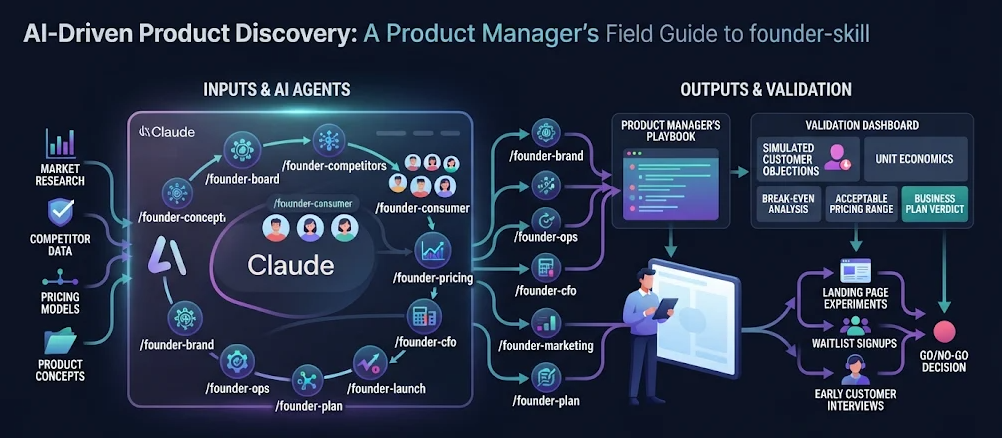
Created by Jake Schincariol, founder-skill is a free, MIT-licensed toolkit designed to run inside Claude. It brings together 11 specialised AI agents, including a simulated board of directors, a 100-agent consumer panel and an automated CFO.
For Product Managers, the promise is compelling: stress-test product concepts, pricing strategies and customer value propositions before committing engineering resources.
But can AI agents replace traditional product discovery? Let's explore the capabilities, benefits, limitations and practical ways to use the toolkit.
1. What Is founder-skill?
founder-skill is an orchestrated workflow of 11 Claude skills supported by four Python scripts.
It operates locally within your development environment, reading and writing structured Markdown and JSON files inside a dedicated founder/ directory.
Rather than relying on open-ended prompts, the toolkit follows a structured discovery sequence:
Board → Competitors → Consumer Panel → Pricing → Offer → CFO → Marketing → Brand → Ops → Launch → Business Plan
Each agent builds on the outputs of previous stages, creating a connected workflow from initial product evaluation through to launch planning.
The 11 specialised agents
| Command | Role | Product Management Application |
|---|---|---|
/founder-board | Board of Directors | Evaluates product concepts using the frameworks of Alex Hormozi, Peter Thiel and Steve Jobs. Produces a score and funding recommendation. |
/founder-competitors | Competitor Scout | Identifies competitors, alternatives, pricing strategies and customer complaints. |
/founder-consumer | Consumer Panel | Simulates 100 potential buyers, or 20 in quick mode, to explore purchase intent and objections. |
/founder-pricing | Pricing Strategist | Applies the Van Westendorp Price Sensitivity Meter to identify acceptable pricing ranges. |
/founder-offer | Offer Architect | Develops value propositions, bonuses and guarantees to address customer objections. |
/founder-cfo | CFO | Models unit economics, break-even points, cash flow and financial runway. |
/founder-marketing | Marketing Director | Defines positioning, acquisition channels, CAC targets and campaign plans. |
/founder-brand | Brand Designer | Develops brand identity, messaging and availability checks. |
/founder-ops | Operations Manager | Maps operational dependencies, suppliers, tools and risks. |
/founder-launch | Launch Lead | Creates staged launch strategies and low-cost validation experiments. |
/founder-plan | Business Planner | Consolidates outputs into a business plan with a profitability assessment. |
PMs don't need to run every agent for every feature. The real opportunity is selecting the relevant capabilities at different stages of discovery.
2. Four Key Benefits for Product Teams
A. Understanding why customers might say no
One of the most interesting capabilities is the simulated consumer panel.
The /founder-consumer skill generates buyer personas with different demographics, habits, income levels and purchasing objections.
Rather than simply producing generic positive feedback, the panel identifies potential reasons customers might reject a product, including:
- Price sensitivity.
- Lack of trust.
- Existing habits and alternatives.
- Insufficient perceived value.
- Lack of urgency.
For Product Managers, these objections can inform product positioning, value propositions and onboarding improvements.
The biggest benefit isn't the simulated buy rate. It's the opportunity to identify weaknesses in the product proposition before development begins.
B. Combining AI reasoning with deterministic calculations
LLMs can make mistakes when performing financial calculations. founder-skill addresses this risk by combining Claude's qualitative reasoning with four locally executed Python scripts.
unit_economics.py: Calculates contribution margins, break-even volumes and runway requirements.van_westendorp.py: Implements the Van Westendorp pricing methodology.panel.py: Generates buyer personas and programmatically counts survey responses.compile.py: Applies mathematical thresholds to determine the final business plan verdict.
For example, the repository's matcha café scenario in Toronto models iced lattes selling for $6.50.
The calculations produce:
- $4.76 contribution margin per cup.
- 186 cups required for daily break-even.
- 383 planned daily sales.
- $25,280 in startup capital.
- Estimated capital payback by Month 8.
This hybrid approach helps separate subjective AI recommendations from calculations that can be independently verified.
C. Free and locally processed
The toolkit is MIT-licensed and its Python helper scripts operate without external network calls or third-party API integrations.
This provides an attractive starting point for teams experimenting with AI-assisted discovery without introducing additional SaaS dependencies.
However, local processing by the helper scripts should not be confused with complete end-to-end privacy: PMs should separately review how Claude processes prompts and connected project data.
D. Encouraging validation before development
The /founder-launch skill promotes a simple principle: test before you spend.
Instead of immediately committing to a full product build, it encourages inexpensive experiments such as:
- Landing page experiments.
- Waitlist registrations.
- Pre-sales.
- Pricing tests.
- Early customer interviews.
This is particularly valuable for teams that tend to over-invest in internal planning before testing assumptions with actual customers.
3. Four Limitations Product Managers Should Understand
Despite its potential, founder-skill has important limitations.
A. Synthetic customers are not real customers
The consumer panel is a simulation, not a representative sample of actual buyers.
LLMs can exhibit agreeability bias, producing overly favourable feedback and less variation than genuine customer research.
Research from Nielsen Norman Group and Maier et al. (2025), cited in the original analysis, highlights concerns around synthetic-user feedback and the gap between stated purchase intent and actual purchasing behaviour.
The practical implication is important:
Treat simulated purchase intent as exploratory feedback, not a reliable conversion forecast.
B. The objection bubble
The consumer panel has another structural limitation.
Its buyer personas receive objections from a predefined list of four to eight customer doubts in founder/customer.json.
If a Product Manager overlooks an important customer objection when configuring the project, the simulation may never explore it.
This creates a classic garbage-in, garbage-out problem.
Ground the initial objections in real customer interviews, support tickets, competitor reviews and market research rather than assumptions.
C. Version 1.0 technical issues
An independent code audit associated with GitHub Issue #1 identified four operational issues in the initial v1.0 release (commit fd9385b).
- Zero-cost profitability bug: Missing operating costs can default to zero, potentially producing an incorrect profitability assessment.
- Offer re-test persistence: Existing buyer response files may be reused during offer re-testing, making before-and-after comparisons unreliable unless previous answers are cleared.
- Decimal comma corruption: European-style prices such as
12,50may be interpreted as1250by the pricing script. - Quick flag parsing: Passing
--quickdirectly to the Python script can cause an execution error because the script expects an integer.
These issues should be checked against the current repository version before deployment, as subsequent releases may have addressed them.
D. Token overhead and execution friction
A full consumer panel involves 100 sequential agent calls.
Depending on Claude Code's permission settings, generated files may also require individual approval, creating unnecessary friction.
For initial experiments, the 20-buyer quick mode is a more practical starting point.
4. The Product Manager's Playbook
To get meaningful value from founder-skill, use it as part of a broader discovery process rather than treating it as an automated decision-maker.
A practical workflow looks like this:
Real Customer Insights → Competitor Analysis → Customer Objections → Quick AI Panel → Technical Checks → Real-World Validation
Step 1: Start with real customer evidence
Run /founder-competitors and review competitor feedback, customer support tickets and user interviews.
Use these findings to populate founder/customer.json with realistic customer personas and objections.
Step 2: Start with a 20-buyer simulation
Use /founder-consumer --quick to explore initial reactions.
Experiment with different messaging, positioning and pricing assumptions before running the full panel.
Step 3: Check the underlying calculations
Before relying on financial outputs:
- Verify that
founder/numbers.jsoncontains every operating cost. - Clear
founder/panel/answers/before offer re-tests if previous responses are being reused. - Use decimal points in pricing inputs, such as
12.50. - Verify calculations independently.
Step 4: Validate with real customers
Use the simulated panel to identify potential objections and refine your proposition.
Then test the strongest hypotheses through landing pages, waitlists, pre-orders or customer interviews.
Real purchasing behaviour should carry more weight than simulated purchase intent.
5. Final Verdict: Is founder-skill Worth Exploring?
founder-skill offers an interesting addition to the Product Manager's discovery toolkit.
Its greatest strength is the structured way it combines competitive intelligence, simulated customer feedback, pricing analysis and financial modelling.
It can help teams challenge assumptions, identify potential weaknesses and explore product opportunities before investing significant engineering resources.
However, it is not a replacement for customer research, usability testing or market validation.
The best way to think about founder-skill is as an AI-powered sparring partner for product strategy.
Use it to discover what might go wrong, understand why potential customers might say no, and improve your product proposition.
But before committing to the build, take those insights into the real world.
Because ultimately, a simulated customer can tell you why they might buy your product. Only a real customer can prove that they will.